Introduction
Most health-conscious individuals don't use just one app , they juggle three, four, sometimes five or more. One app for calorie tracking, another for workout logging, a third for sleep analysis, a meditation app, a recipe platform, and maybe a step counter that came pre-installed on their phone. At face value, this seems like the smart move: each app is "best-in-class" for its niche, so why not use them all?
The reality is far less efficient. Constant app switching creates a compounding tax on your time, attention, and motivation. It fragments your health data into silos, makes patterns invisible, and adds cognitive friction to every tracking decision. Over months and years, this friction accumulates into hundreds of lost hours and missed insights that could have driven meaningful progress.
This guide quantifies the hidden costs of fragmented health tracking and explains why streamlined, all-in-one platforms are not just more convenient , they're fundamentally more effective.
The Hidden Tax of App Switching
Every time you open a different app to log a meal, record a workout, check your step count, or review your sleep data, you pay a small but real cost. Individually, each task takes only seconds. But these micro-interruptions compound across days, weeks, and months into a substantial expenditure of time and mental energy.
Context Switching Time
Opening a new app, waiting for it to load, navigating to the correct screen, and logging data takes 20–45 seconds per switch. Do this 8–12 times daily, and you lose 15–25 minutes per day.
Cognitive Load
Each app has its own interface, navigation logic, and data entry method. Your brain must reload these mental models repeatedly, increasing decision fatigue and reducing tracking consistency.
Fragmented Progress Visibility
When your food, fitness, sleep, and weight data live in separate apps, you can't see how they interact. This makes it nearly impossible to identify what's actually working.
Inconsistent Data Sync
Apps rarely communicate properly. A workout logged in one app won't adjust your calorie budget in another. Manual correction wastes more time and introduces errors.
Subscription Fatigue
Using premium features across multiple apps means paying $10–$20/month per service. This adds up to $500–$1,200 annually for fragmented functionality.
Quantifying the Time Cost
Let's break down exactly how much time is wasted by fragmented health tracking across a typical day, week, and year.
Daily Activity Breakdown
Meal Logging (3 meals + 2 snacks)
- Open calorie tracking app: 5 times × 8 sec = 40 sec
- Search for foods and log quantities: 5 times × 90 sec = 7.5 min
- Check macros and adjust portions: 2 min
- Total: 10 minutes
Workout Logging
- Open fitness app and navigate to workout log: 12 sec
- Log exercises, sets, reps, and weights: 4 min
- Open separate cardio app to log run/bike: 45 sec
- Manually note active calories in calorie app: 30 sec
- Total: 5.5 minutes
Sleep & Recovery Tracking
- Open sleep app to review previous night: 30 sec
- Check steps in phone's health app: 20 sec
- Open meditation app for breathing exercise: 15 sec
- Total: 1 minute
Progress Review
- Open weight tracking app: 8 sec
- Log daily weight or body measurements: 45 sec
- Switch back to calorie app to see weekly average: 20 sec
- Switch to fitness app to check training volume: 30 sec
- Total: 1.5 minutes
Recipe Browsing & Meal Planning
- Open recipe app to search for dinner ideas: 25 sec
- Switch to calorie app to check if recipe fits macros: 30 sec
- Manually calculate ingredient adjustments: 2 min
- Add custom recipe to food database: 1.5 min
- Total: 4.5 minutes
Troubleshooting Sync Issues
- Notice workout didn't sync to calorie tracker: 15 sec
- Force refresh or reconnect app integrations: 45 sec
- Manually enter missing data: 2 min
- Verify calorie adjustments are now correct: 30 sec
- Total: 3.5 minutes (occurs 2-3 times/week)
Weekly Review & Data Export
- Open each app individually to review weekly stats: 3 min
- Take screenshots or export data for personal records: 2 min
- Manually calculate weekly averages across platforms: 2.5 min
- Update personal spreadsheet with combined data: 3 min
- Total: 10.5 minutes weekly (1.5 min/day average)
Total Daily Time Cost
23.5 minutes per day spent switching between apps, navigating interfaces, manually syncing data, and troubleshooting issues.
Weekly: 2 hours, 45 minutes
Monthly: 11.75 hours
Yearly: 143 hours , nearly 6 full days
Over 100 Hours Per Year Wasted
If you're using 4+ separate health apps, you're spending the equivalent of nearly 5 full days annually just navigating between platforms, re-entering data, and trying to piece together insights from disconnected sources. An all-in-one platform eliminates 80–90% of this overhead.
The Mental Load of Fragmented Tracking
Time is only one dimension of the cost. The psychological burden of managing multiple apps , each with its own login, interface, notification settings, and subscription status , creates persistent low-grade stress that erodes motivation and consistency.
Decision Fatigue
Every time you need to track something, you face a series of micro-decisions: Which app do I open? Did I already log breakfast? Should I log this snack in the calorie app or the macro tracker? Did my workout sync to the nutrition app? These decisions seem trivial individually, but they consume executive function capacity , the same mental resource required for discipline, planning, and goal pursuit.
Research from behavioral psychology shows that decision fatigue reduces self-control in subsequent choices. By the end of a day spent managing multiple apps, you have less willpower left for the decisions that actually matter: choosing a healthy dinner, going to the gym, or preparing meals for tomorrow.
The "Out of Sight, Out of Mind" Problem
When your health data is scattered across multiple platforms, no single view captures your complete picture. You might see that your weight went up this week in one app, but without immediately seeing your logged workouts, sleep quality, and calorie intake in the same view, you can't identify the cause. This delays corrective action and creates frustration when progress stalls.
The Power of Unified Context
All-in-one platforms create contextual awareness , your workout data sits next to your calorie intake, which sits next to your weight trend and sleep quality. Patterns that would take hours to manually correlate across apps become immediately visible.
Data Silos: The Invisible Progress Killer
Fragmented tracking doesn't just waste time , it actively prevents you from understanding what drives your results. When each metric lives in isolation, you lose the ability to see the connections that matter most.
Sleep & Weight Connection
Poor sleep increases cortisol and disrupts hunger hormones, leading to weight gain. If your sleep app and weight app don't talk to each other, this pattern stays invisible.
Training Volume & Recovery
Logging workouts in one app and tracking soreness or energy in another makes it impossible to identify when you're overtraining or underrecovered.
Calorie Adjustments
If your fitness tracker says you burned 600 calories but your nutrition app doesn't automatically adjust your target, you either undereat (losing muscle) or overeat (slowing fat loss).
Nutrition Timing
Seeing how pre-workout meals affect your performance requires your food log and workout log in the same place. Split apps make this trial-and-error process nearly impossible.
Macro Balance
Tracking protein intake in one app while monitoring muscle gain in another prevents you from knowing if you're eating enough to support growth.
Weekly Patterns
Did poor weekend eating tank your progress, or was it missed workouts? Without unified weekly summaries, you're guessing instead of adjusting strategically.
Hydration & Performance
Low water intake affects workout performance, energy levels, and recovery. When hydration tracking lives separately from fitness and energy logs, this critical connection remains hidden.
Stress & Eating Patterns
High-stress days trigger emotional eating and poor food choices. Without mood tracking integrated with nutrition logs, you can't identify stress-related eating triggers.
Consistency & Long-Term Trends
Are you actually consistent, or just consistent in one area? Unified tracking reveals whether you're nailing workouts but missing nutrition targets, or vice versa.
Data Silos: The Invisible Progress Killer
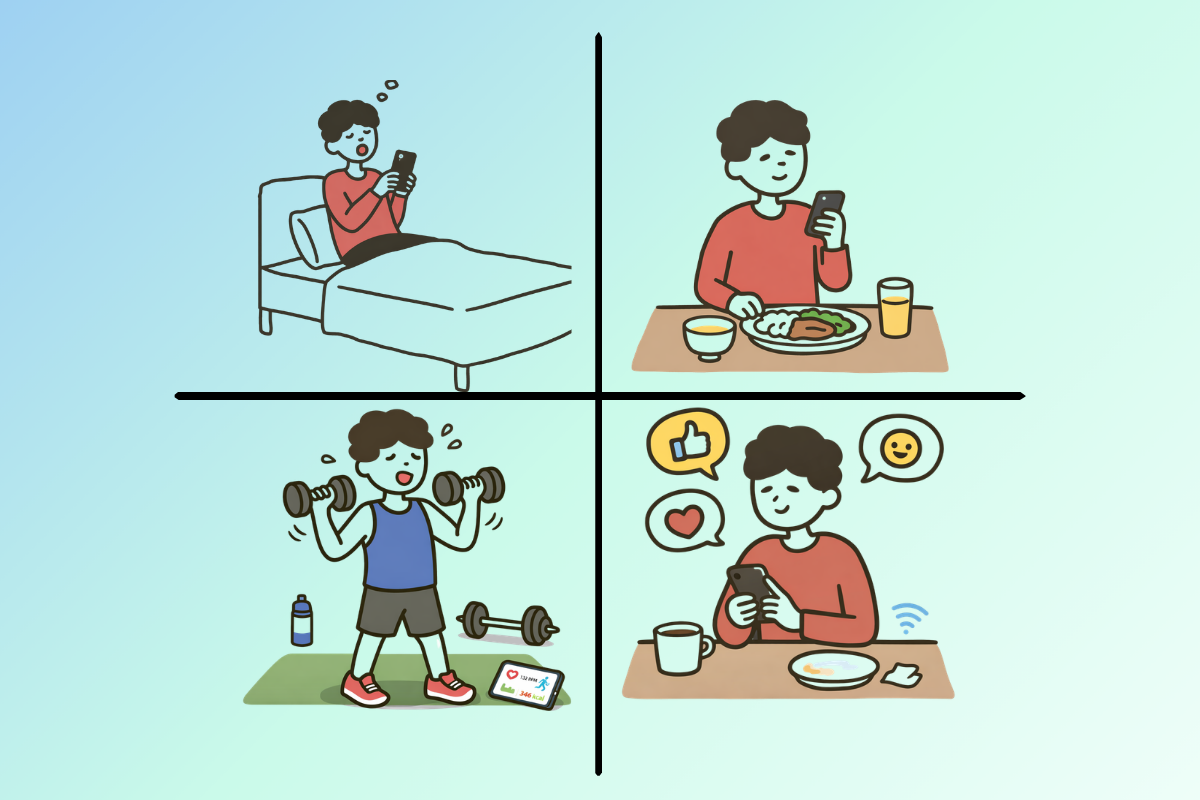
When your nutrition, fitness, and health apps don’t share data, it’s hard to see the full picture. Fragmented tracking can hide patterns, slow progress, and make it difficult to reach your goals.
Security, Privacy, and Subscription Sprawl
Beyond time and mental energy, fragmented app usage introduces practical risks and costs that often go unnoticed until they become problems.
Login Credential Management
Each app requires a separate account, email verification, password, and potentially two-factor authentication. Managing 5+ sets of credentials increases the likelihood of forgotten passwords, locked accounts, and security vulnerabilities. Password reuse across apps , a common shortcut , dramatically increases your exposure if any one service is breached.
Privacy and Data Sharing
More apps mean more companies holding your health data, each with its own privacy policy, data retention practices, and third-party sharing agreements. Few users read these policies, meaning sensitive health information may be shared or monetized without full awareness. All-in-one platforms reduce your data exposure footprint by centralizing control under a single privacy agreement.
The Subscription Tax
Premium versions of popular health apps cost $8–$20/month each. Using separate apps for nutrition tracking ($10/month), fitness logging ($15/month), meal planning ($12/month), and meditation ($13/month) totals $600 annually , often more than a comprehensive all-in-one platform offering the same features in a unified experience.
Consolidation Reduces Risk
Using a single trusted platform for all health tracking reduces the number of companies with access to your data, limits subscription sprawl, and simplifies credential management , all while improving functionality through unified context.
What Makes an Effective All-in-One Platform?
Not every app that claims to be "all-in-one" actually delivers on the promise. Truly effective unified health platforms share several key characteristics that eliminate fragmentation without sacrificing depth or usability.
Comprehensive Food Database
A robust nutrition tracker with barcode scanning, meal templates, and recipe builder , not a watered-down afterthought tacked onto a fitness app.
Full Fitness Logging
Ability to log strength training (sets, reps, weights), cardio sessions (duration, distance, calories), and track active minutes and heart points , all in one workout log.
Unified Dashboard
A single view that surfaces calories consumed, calories burned, macros, weight trend, workout volume, and sleep quality together , creating instant contextual awareness.
Intelligent Insights
AI or analytics that connect the dots between your behaviors: How does sleep affect your workout performance? How does protein intake correlate with muscle retention?
Community and Accountability
Social features, challenges, leaderboards, or group support built into the platform , eliminating the need for separate fitness social networks.
The Case for All-in-One: Real-World Benefits
Switching to a unified health platform delivers measurable improvements in both efficiency and effectiveness. Users who consolidate from multiple apps into a single platform consistently report several key benefits.
Time Savings
By eliminating app switching, redundant logins, and manual data syncing, users reclaim 80–90% of the time previously lost to fragmentation , turning 18 minutes per day into 2–3 minutes. Over a year, this translates to 90+ hours saved , time that can be reinvested in meal prep, workouts, or simply reducing daily stress.
Improved Consistency
Lower friction correlates directly with higher adherence. Research on behavior change shows that reducing the number of steps required to complete a habit increases long-term compliance by 40–60%. Users are far more likely to log meals, track workouts, and monitor progress when everything lives in one place.
Faster Progress
Unified dashboards make patterns immediately visible. Users can see within seconds whether they're achieving their protein target, hitting their step goal, and recovering adequately , enabling faster course correction when something isn't working. This accelerates progress by reducing the lag between behavior and feedback.
Glewell's Unified Approach
Glewell consolidates food tracking, fitness logging, sleep monitoring, progress analytics, meal planning, recipe library, workout builder, and AI coaching into a single dashboard. Active calories from workouts automatically adjust your daily nutrition targets. Sleep quality, workout volume, and weight trends appear side-by-side so you can see what's driving results , or what's holding you back.
When Multi-App Use Makes Sense
While all-in-one platforms work exceptionally well for most users, there are niche scenarios where maintaining separate specialized apps may still be justified.
Elite Athletes with Sport-Specific Needs
Professional or competitive athletes in disciplines like cycling, running, or swimming may benefit from highly specialized apps (e.g., TrainingPeaks, Strava) that offer advanced analytics, power meters, VO2 max estimates, and training load algorithms tailored to their sport. For these users, a nutrition-focused all-in-one app plus one sport-specific tracker may be the optimal compromise.
Users with Medical-Grade Monitoring Needs
Individuals managing chronic conditions (diabetes, hypertension, heart disease) may require FDA-cleared or medical-grade apps that integrate directly with clinical systems. In these cases, a medical app plus a general wellness platform may be necessary until more comprehensive medical-grade unified platforms emerge.
Deep Integrations with Specialized Hardware
Users heavily invested in specific wearable ecosystems (Garmin, Whoop, Oura) may prefer their native apps for full feature access. However, many all-in-one platforms now integrate with these devices, allowing you to sync data without living exclusively in the hardware manufacturer's app.
The Two-App Rule
If you genuinely need specialized functionality beyond what an all-in-one platform offers, limit yourself to two apps maximum: one unified platform for general health tracking, and one niche tool for specialized needs. Going beyond this reintroduces fragmentation without meaningful benefit.
How to Transition from Fragmented to Unified Tracking
Consolidating health apps feels daunting when you've accumulated years of data and established habits across multiple platforms. A structured transition plan makes the process manageable and ensures you don't lose momentum or historical context.
Step 1: Audit Your Current App Stack
List every health-related app you currently use, what data it tracks, and whether you actively use it weekly. Many people discover they're paying for subscriptions they rarely open. Cancel inactive apps immediately.
Step 2: Identify Your Core Needs
Define your non-negotiables: Do you need barcode scanning for food logging? Workout builder functionality? Sleep tracking? AI coaching? Write down your top 5 must-have features to guide your platform selection.
Step 3: Test the All-in-One Platform
Most comprehensive platforms offer free trials or freemium tiers. Use the new platform in parallel with your existing apps for 1–2 weeks. Log meals, workouts, and weight in both systems to compare functionality, ease of use, and whether the unified dashboard delivers the promised insights.
Step 4: Export Historical Data (If Needed)
If you have years of data you want to preserve, check whether your old apps allow CSV export and whether the new platform supports import. However, most users find that starting fresh is psychologically freeing , past data rarely influences daily decisions, and a clean slate reinforces commitment to the new system.
Step 5: Commit Fully for 30 Days
Once you've validated the platform works for you, delete or uninstall your old apps and commit exclusively to the unified system for 30 days. Partial adoption reintroduces fragmentation , the benefits of consolidation only materialize when you fully commit.
The 30-Day Test
Research on habit formation shows it takes 21–30 days to establish a new behavior pattern. Give yourself one full month of exclusive use before evaluating whether the unified approach is working. The time savings and reduced friction compound over this period, making the benefits increasingly obvious.
Conclusion
The fragmented health app ecosystem wasn't designed with your efficiency, mental energy, or goal achievement in mind , it was designed to serve the business interests of dozens of companies competing for subscription revenue. You pay the price: in time wasted switching apps, in mental load managing multiple platforms, in invisible data silos, and in subscriptions that add up to hundreds of dollars annually.
The solution is consolidation. All-in-one platforms eliminate 80–90% of the overhead while providing superior insights through unified data. You save over 100 hours per year, reduce decision fatigue, and gain immediate contextual awareness that makes patterns and problems instantly visible. Your nutrition, fitness, sleep, and progress live in one dashboard , the way they should have all along.
The best time to consolidate was when you first started tracking. The second-best time is now.
One App. All Your Health Data. Zero Fragmentation.
Glewell combines food tracking, workout logging, meal planning, recipe library, sleep monitoring, progress analytics, and AI coaching in a single unified platform. Stop switching apps. Start seeing results.
Try Glewell Now